The Census at Bethlehem
by Pieter Brueghel the Younger
by Pieter Brueghel the Younger
Origin
Belgium (Antwerp), ca. 1610–1620
Current location
Lille, Palais des Beaux-Arts de Lille, inv. P.863
Dimensions
H. 112; W. 163 cm
Medium
Oil on canvas.
Description
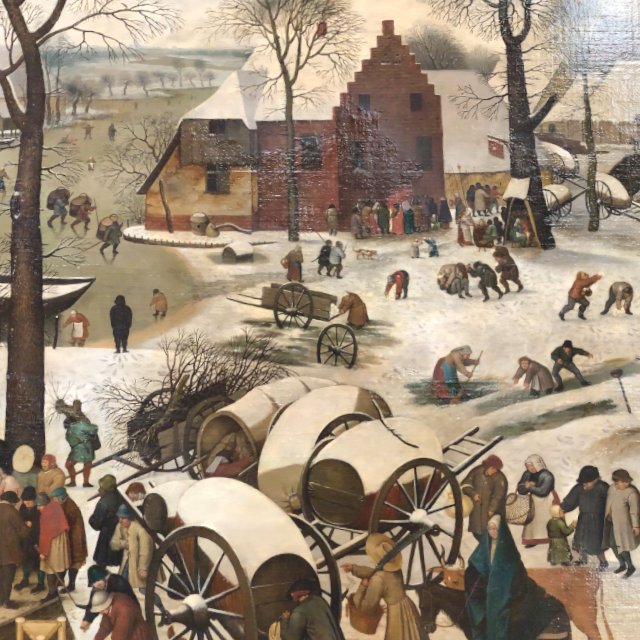
In the middle of a snow-covered landscape, villagers go about their business. We are in Flanders, as shown by the typically Flemish stepped gable of the house in the background. A crowd of figures converges towards an inn in the foreground. There they come to pay their taxes, in cash or in kind: chickens, eggs, wheat…
But now a strange group approaches. A woman dressed in blue and seated on a donkey is accompanied by an ox and by a man carrying a saw. These are the Virgin Mary and Joseph the carpenter, the parents of Christ. They have come to be counted in their town of origin, as the law required.
History
The painter chose to set the scene in a region familiar to him, Flanders, even though this biblical episode takes place in Bethlehem, today in Palestine. He decided to place these figures, who lived 1,600 years before him, in a contemporary setting, as if the scene had taken place in his own time!
While the date of the event is not stated, the Bible tells us. It is 24 December. Which means that Mary is about to give birth!
Pieter Brueghel the Younger produced at least thirteen versions of this theme, which he copied from a work by his own father. But there is no cause for scandal! In the sixteenth century, painters belonging to the same workshop and working together could share their subjects with one another!
State of conservation
The state of conservation is good.