Baptismal Font
Baptismal Font
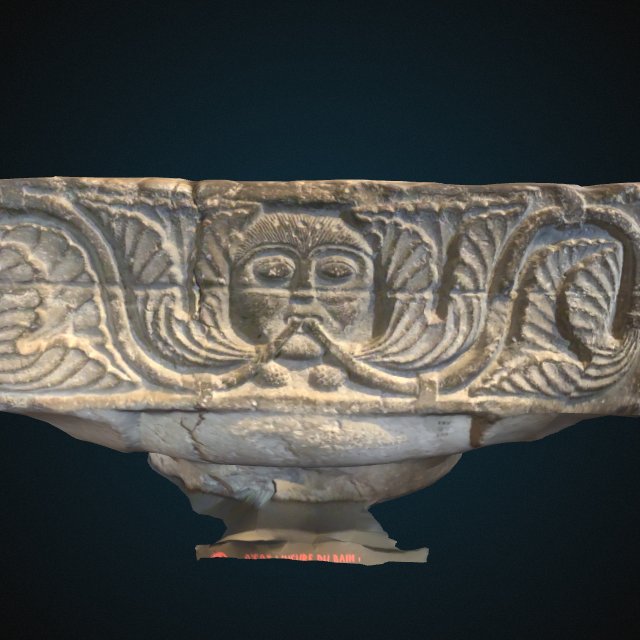
Baptismal Font
Origin
Northern France (Cousolre), ca. twelfth century
Current location
Lille, Palais des Beaux-Arts de Lille, inv. LAP 1
Dimensions
H. 50; W. 89; D. 66.5 cm
Materials
Stone.
Function
This baptismal font was a piece of ecclesiastical furnishing used for baptism by aspersion in Christian churches. The basin is wide enough to hold a child's head and to contain a small quantity of water (about 1 to 2 litres).
Inscriptions
Several decorative motifs are represented on the square panel of this baptismal font:
- An architectural decoration featuring six semicircular round arches resting on seven columns. This decoration is notable for appearing on two faces of the panel, opposite one another.
- A decoration depicting a half-human, half-animal monster spewing foliate scrolls.
- A decoration depicting a giant lion, symbolising the devil, attacking a man and a woman separated by a tree. Long thought to represent Adam and Eve, they are in fact Saint Walbert and his wife Saint Bertille, the supposed founders of the first church of Cousolre in the seventh century.
History
Dated to the twelfth century, this object was used throughout the Middle Ages in the church of Notre-Dame in Cousolre (Nord) to baptise newborns. But in the sixteenth century it was decided to rebuild the church, which was then dedicated to Saint Martin. New furnishings were designed and the baptismal font, set aside, ended up in a garden, serving as a basin to collect rainwater.
It is thanks to its rescue by Mr Jennepin that we can today admire its decoration, characteristic of Romanesque art.
State of conservation
The state of conservation is good.
The ordeals of moving the baptismal font outdoors have nonetheless left their marks, causing the loss of the basin's original base as well as its cover.