Saint Jerome
by José de Ribera
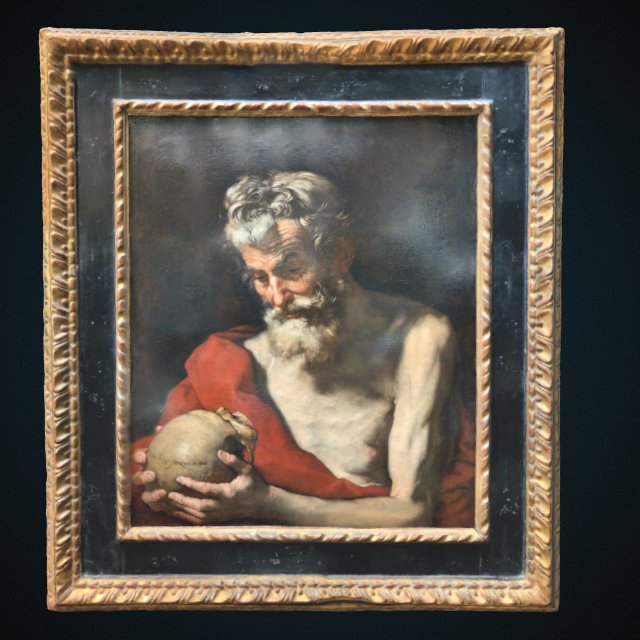
by José de Ribera
Origin
Italy (Naples), 1643
Current location
Lille, Palais des Beaux-Arts de Lille, inv. P.42
Dimensions
H. 78; W. 65 cm
Medium
Oil on canvas.
Description
Jerome is one of the four great Doctors of the Church, along with Augustine, Ambrose and Gregory the Great. After studying Greek and Latin, he withdrew into the desert to do penance. On his return, he was entrusted with translating the Bible into Latin, the version known as the Vulgate.
He is often depicted as a half-naked, bearded hermit. Legend also gives him the red cloak and hat of a cardinal, which he in fact never was. The lion, the skull and the book are further attributes linked to certain episodes of his story.
Techniques
Hermit saints are a favourite subject in the painting of José de Ribera. Saint Jerome is depicted some forty times! In this version from the artist's maturity, the figure is treated as a bust in a tight framing and a restrained format. The saint is focused on the skull, his sole object of meditation. He is represented without any of the other attributes of his traditional array. Reduced to its simplest expression, his representation conveys man face to face with his destiny. The mere evocation of the cult of penance is here transcended!
This austerity is treated in a naturalist style: Ribera's painting makes one physically feel the reality of matter, and the contrasting light lends the scene a dimension of gravity.
One can observe the artist's signature and the date of execution, 1643, on the skull held by the saint.
State of conservation
The state of conservation is good.