Saint Catherine
Saint Catherine
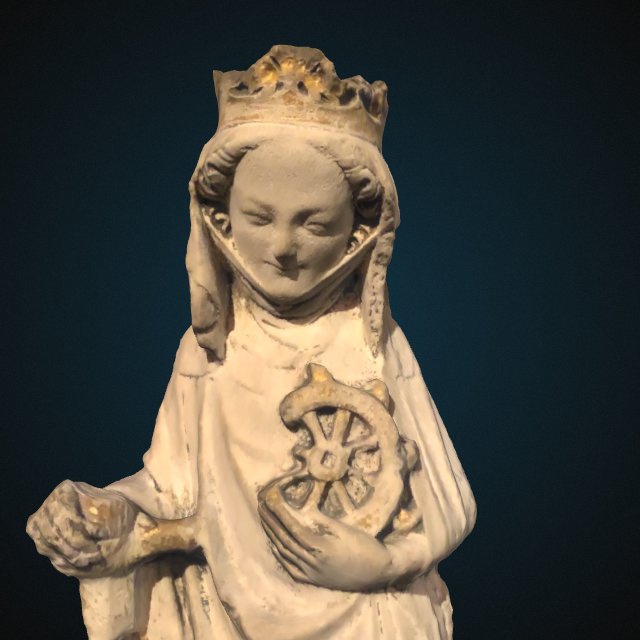
Saint Catherine
Origin
Northern France (Lille), ca. fourteenth century
Current location
Lille, Palais des Beaux-Arts de Lille, inv. A.2827
Dimensions
H. 71.5; W. 24; D. 18 cm
Materials
Stone.
History of the Figure
Saint Catherine of Alexandria is said to have lived in the third century AD, in Egypt. The daughter of a king, she received a careful education and developed an intelligence admired by all. But one day, seeing Christians being massacred, she confronted the emperor Maxentius and tried to prove to him that there is only one god, the god of the Christians. Although the emperor was charmed by the young woman's beauty, he was not convinced. He then summoned to Alexandria an assembly of scholars, meant to reason with Catherine. But instead, she managed to convert them. Imprisoned, she even succeeded in converting Maxentius's own wife! Enraged, he decided to subject her to the torture of the wheel, from which she miraculously escaped, and then to have her beheaded.
This account, drawn from the "Golden Legend" of Jacobus de Voragine, inspired a great many works of art throughout the Middle Ages. In these works, Catherine is recognisable by her attributes: the wheel of her torture (here in her left hand) and the sword that beheaded her (part of which can still be seen in her right hand).
At the saint's feet lies the head of the man who condemned her and on whom she takes her revenge by trampling him underfoot: the emperor Maxentius. He symbolises paganism and evil, over which the Christian succeeds in triumphing.