Capital of the Life of Christ
Four stages in the life of Christ
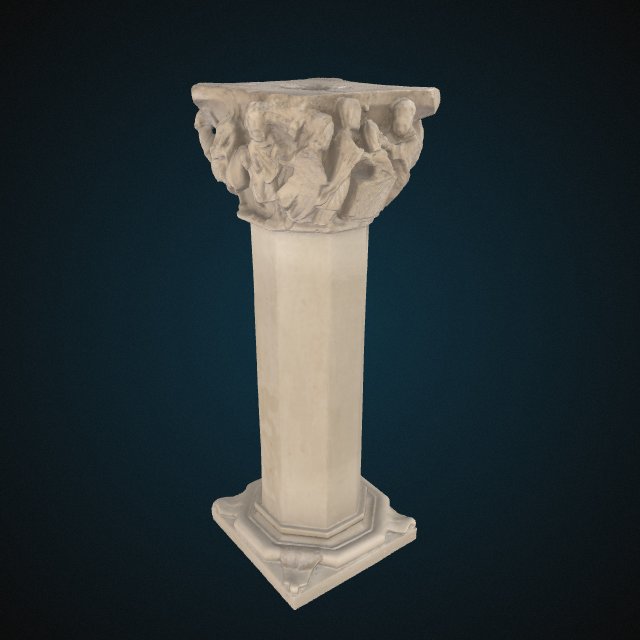
Four stages in the life of Christ
About
The cloister of the Collegiate Church of Notre-Dame-en-Vaux housed a unique collection of finely crafted column-statues depicting scenes from the Old and New Testaments. Erected around 1170–1180, these sculptures served the canons as aids for contemplation and instruction. Although emblematic of the early Gothic style, this artistic trend was short-lived and soon abandoned in the wake of subsequent liturgical reforms.
This capital depicts four major events in the life of Christ, drawn from the texts of the New Testament. Two scenes from his childhood, the Flight into Egypt and the Presentation at the Temple, along with two scenes from his adult life, the Baptism in the waters of the Jordan and the Raising of Lazarus.
Notably, this capital has an octagonal shape, which is unusual for the period. This form allows for the addition of faces beneath the capital's crockets, serving as subtle transitions between the various scenes depicted.
Historical Background
Severely lacking funds for the upkeep of their cloister in the 18th century, the monks proceeded with the demolition of the cloister between 1759 and 1766. The cloister was destroyed, and the grounds were rebuilt using the debris for the foundations. The cloister and its sculptures would fall into obscurity for two centuries, escaping the destruction of the Revolutionary period. Rediscovered in fragments during excavations by Léon Pressouyre between 1963 and 1976, it was reassembled and supplemented with plaster reinforcements.
State of Preservation
The capital is highly fragmented, with many parts missing, in particular the heads of the Christ Child, which have completely disappeared. A large portion of the figures' heads are also incomplete.