Reliquary Cross
Reliquary cross of the True Cross, known as the Reliquary Cross of Wasnes-au-Bac
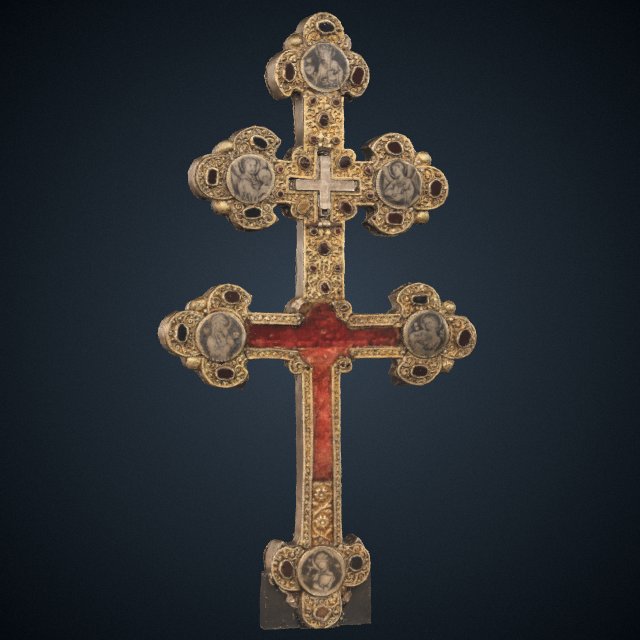
Reliquary cross of the True Cross, known as the Reliquary Cross of Wasnes-au-Bac
Origin
Artois or Flanders (?), ca. 1220-1230 Lille
Current location
Palais des Beaux-Arts, inv. A 97
Dimensions
H. 38.4; W. 17.9; D. 1.6 cm
Materials
Gilded silver, chased and engraved on a walnut core; filigree, niello, cabochons.
Exhibitions
Lille 1874, no. 1574; Paris 1889, no. 286; Lille 1947, no. 47; Paris/Saint-Omer 2013, no. 112
Relic
On the obverse: a relic of the True Cross was originally kept in the small compartment at the intersection of the upper crossbar. In the modern period it was replaced by a small engraved cross depicting the crucified Christ.
History
This cross comes from the church of Saint-Martin in Wasnes-au-Bac, a parish located not far from Valenciennes that was dependent on the abbey of Vicogne and the collegiate church of Saint-Amé in Douai. It was acquired as early as 1896 by the Palais des Beaux-Arts in Lille, where it is exhibited.
State of conservation
The object is in fair condition and underwent a light cleaning in 2021. Some precious stones are missing from the filigree, and most of the nielloed medallions have lost their brilliance. On the reverse, all the borders of the plaques at the extremities are damaged and the niello is slightly oxidised.
Assessment of authenticity
On the obverse, a modern cross replaces the relic in the compartment of the upper crossbar, while the applied figure of Christ has disappeared (it had been replaced by another Christ in the 19th century). Modern red velvet. In 2021, the obverse medallions were repositioned according to their original arrangement.
Iconography
The presence—rare—of figured medallions and plaques on both faces of the cross makes it one of the most complete in the corpus from an iconographic point of view.
On the obverse, the extremities of the two crossbars are decorated, from left to right and top to bottom, with an angel bearing a host, a second angel bearing the Tables of the Law, the Virgin of the Crucifixion, and Saint John of the Crucifixion. At the extremities of the upright are depicted, above, the crowned Church holding a ciborium and the Gospels or the Bible and, below, the blindfolded Synagogue, holding the same Tables of the Law as well as a broken lance.
On the reverse, at the intersection of the upper crossbar is a Maiestas Domini, framed by two thurifer angels on the fleur-de-lis extremities. At the centre of the lower crossbar, the cross-bearing Agnus Dei is surrounded, on the four remaining extremities, by the Tetramorph, each symbol unfurling a phylactery.
Commentary
For commentary on this work see: Lucas Fellag, L’iconographie des croix reliquaires septentrionales (fin XIIe-début XIIIe siècle), 3 vols., unpublished research thesis, Master 2 in art history, under the supervision of Marc Gil, Université de Lille, June 2020, vol. III, cat. 6.
Bibliography
- Dehaisnes 1886, p. 302
- Dehaisnes 1897, p. 141-142
- Frolow 1961, n° 643
- Frolow 1965, n°643
- De Borchgrave d’Altena 1966, p. 112
- Lavallée 1997, pp. 86-87
- Coipel 2004, n°3
- Tapié 2006, p. 24-27
- Fellag 2020, III, cat. 6.