Censer
Censer with the Hebrews in the Furnace
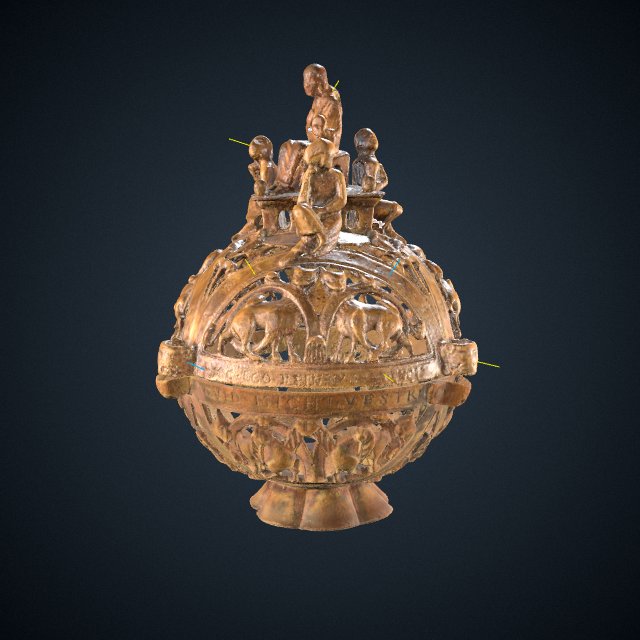
Censer with the Hebrews in the Furnace
Origin
Mosan region (Liège?), ca. 1160
Current location
Lille, Palais des Beaux-Arts, inv. A. 82
Dimensions
H. 16; W. 10.4 cm
Materials
Cast brass, chased and gilded
Exhibitions
Cologne 1968, p. 39; Brussels-Cologne 1972, cat. G. 15, p. 253 (Dietrich Kötzsche); Namur 2010-2011, cat. 14, p. 194-197 (Damien Berné); Paris-Saint-Omer 2013, cat. 26, p. 90-91 (Christine Descatoire).
Perimeter inscription
+ HOC . EGO . REINER(U)S . DO . S†GNU(M) / QUID . MICHI VESTRIS / EXEQUIAS SIMILES . / (D)EBETIS . MORTE . POTITO / ET . REOR . ESSE. PRECES / V(EST)RAS TIMIAMATA . XR(IST)O
Inscriptions on the arches that serve as a perch for the three Hebrews
ANANIAS ; AZARIAS ; MISAEL
History
Early 19th century, a church in the vicinity of Lille; a Lille goldsmith who is said to have exchanged it for objects of his own making; Charles Benvignat, a Lille architect (1805-†1877), who donated it to the museum of Lille between 1874 and 1877.
State of conservation
Heavy wear of the reliefs, particularly of the four figures; the angel at the summit, who came to save the three Hebrews from the furnace, has lost its wings. This censer gave rise to numerous copies, following the early publication by Didron (1846).
Commentary
The censer is composed of two openwork hemispherical bowls, once held by small chains and articulated by semicircular arches that form three circles cutting across a double horizontal band. This strictly geometric structure contrasts with the exuberance of a decoration of foliate scrollwork inhabited by pairs of griffins, winged lions, and confronted eagles. Furthermore, the tabs that fasten the chains recall the sculpted corbels of contemporary architecture. The goldsmith or brass-worker naturally drew inspiration from the Romanesque decorative vocabulary then in use in the monumental and decorative arts.
At the summit, the figurines of the young Hebrews—Ananias, Azarias, and Misael—raise their eyes towards the enthroned angel (now without wings), who saved them from the furnace to which Nebuchadnezzar had condemned them for refusing to worship a golden idol. Thus, as Damien Berné emphasises (Namur 2010-11):
“Indeed, the tension perceptible in the organic profusion of the sphere seems to be resolved in the play of gazes that rise, trusting, towards heaven. Thus, the theme of the figured decoration of the object corresponds perfectly to its liturgical use: the openings of the censer allow the vapours of incense to escape along with the glow of the embers, metaphorically re-enacting the episode of the fiery furnace.”
This famous episode of the Old Testament, borrowed from the Book of Daniel (Dan. III), is both a metaphorical and a typological image (a correspondence between the Old and the New Testament) of unshakeable faith in the all-saving power of God, to which the three young men entirely surrender themselves; a faith that “quenched the violence of fire” (Epistle to the Hebrews, 11, 33). This fire also refers to the furnace of the Last Judgement, from which the righteous will emerge victorious at the end of time, for their eternal salvation. Moreover, the angel who dominates the Hebrews on the censer is seen in the Christian tradition as the Son of God, who came to save them through the word that extinguishes the flames. Finally, the three Hebrews, models of faith for the Christian, also belong to the type of martyrs who make of themselves a voluntary offering to God, thereby recalling the Apocalypse of John (Rev. 8, 3-4):
“Another angel came and stood at the altar, holding a golden censer. He was given a great quantity of incense to offer, with the prayers of all the saints (...) And so the smoke of the incense rose with the prayers of the saints, from the hand of the angel, before God.”
This offering of incense and prayers to God for the salvation of souls is indeed that of this Reinerus (Renier) whose name appears in the perimeter inscription:
“I, Renier, give this censer as a sign, so that at the hour of my death you may grant me a funeral like your own, and I believe that your prayers will be as incense for Christ.”
It is now accepted that this Renier is not the caster Renier de Huy, creator of the famous baptismal font of Notre-Dame in Liège, now in the church of Saint-Barthélemy. He is without doubt the patron and donor of the work to an unknown church. Despite their heavy wear, the figurines refer, by their silhouette, their attitude, and the style of their draperies, to Mosan goldsmithing of the 1150s, in particular the evangelists of the Portable Altar of Stavelot (Brussels, Musées Royaux d’Art et d’Histoire), the allegorical figures of a pair of candlesticks preserved in Hildesheim in Germany (Paris-Saint-Omer 2013, cat. 13), and the angels at the base of a cross in the Victoria and Albert Museum (Cologne-Brussels 1972, G. 14).
Thus the complex iconography and the name of the donor engraved on the object make the Lille censer one of the most original creations of 12th-century Mosan brasswork and an isolated work within the typology of Rhenish-Mosan censers of the middle of the century.
Bibliography
Guy Blazy (ed.), Trésor des églises de l’arrondissement de Saint-Omer, exh. cat. (Saint-Omer, Musée Sandelin, 1992), Saint-Omer, 1992, cat. 3, p. 42-45 (entry by Élisabeth Taburet-Delahaye)
- Didron 1846, IV, p. 305-311, pl. p. 292
- Viollet-Le-Duc 1871, IV, p. 99 et pl. 31
- Destrée 1904
- Théodore 1921
- Usener 1933, p. 116 et suiv.
- Falke et Meyer 1935, p. 9
- Gevaert 1943, n° 13
- Collon-Gevaert 1951, p. 178 et suiv
- Swarzenski 1954, p. 66 et fig. 346
- Swarzenski 1958, p. 43-45, fig. 15
- Schnitzler 1959, p. 27
- Collon-Gevaert, Lejeune et Stiernnon 1961, n°36
- Ruhstaller 1973, p. 102, fig. 1-3
- Oursel 1984, n° 2
- Guide 1997, p. 26-27
Marc Gil, 2023