Plaque
Plaque of Gideon and the Fleece
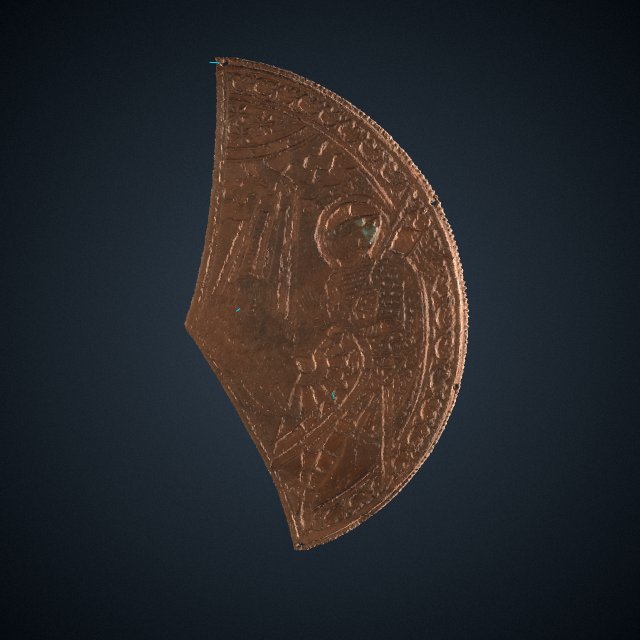
Plaque of Gideon and the Fleece
Origin
Mosan region, ca. 1160 Current location: Lille, Palais des Beaux-Arts, Inv. A 54
Dimensions
H. 23.6; W. 13.2 cm
Materials
Champlevé enamel on gilded copper
Inscription
GEDEON ; HIC ROS STILLAT IN VELLERE (“let the dew fall drop by drop upon the fleece”) ; CONCA (“cup”)
Technique
Trial engravings on the reverse of the plaque, depicting a small lion’s head: a punch mark or rather a goldsmith’s “rough draft.” Along the edge, holes for fixing the plaque.
State of conservation
The enamel has entirely disappeared, except for a few fragments of blue enamel on Gideon’s helmet. The gilding has also disappeared.
Commentary
This copper plaque, engraved then enamelled and gilded, illustrates the episode of Gideon and the Fleece, taken from the Book of Judges (6, 36-40). God, angered against the people of Israel who had relapsed into idolatry, delivers them to the Midianites for seven years. At the end of this time, God, invoked by the repentant Israelites, designates Gideon, the weakest of his tribe, to deliver Israel from its oppressors. The plaque illustrates the moment when Gideon, identified by an inscription, asks God for a first proof of his trust in him to deliver his people (6, 36-38):
“If you really mean to deliver Israel by my hand, as you have said, here I am spreading a fleece of wool on the threshing floor. If there is dew only on the fleece while all the ground remains dry, then I shall know that you will deliver Israel by my hand, as you have said. And so it was. Gideon rose early the next morning, wrung the fleece and pressed the dew out of it, a full cup of water.”
Like a 12th-century knight, Gideon is already armed and clad in his military equipment: a brogne (a tunic covered with plates of metal and leather) over a hauberk (a shirt of metal mail), breeches with leg bindings for the legs, and a conical helmet on his head. He wears a sword at his waist and holds a round shield with a boss. Slightly bowed, he addresses God, whose hand, emerging from the clouds beneath a starry night sky, blesses Gideon and sprinkles the fleece with dew (rays of light), as the Latin inscription indicates: HIC ROS STILLAT IN VELLERE, “let the dew fall drop by drop upon the fleece”; dew that the young hero gathers in a cup (CONCA).
By its indented quarter-circle shape, the plaque must have formed part of a larger enamelled composition of typological significance, of polylobed form, perhaps around the figure of the Virgin Mary (Swarzenski, fig. 17). Indeed, the episode of Gideon and the Fleece, through the miracle of the fleece damp with dew on ground that remained dry (1st proof) and the fleece that remained dry on wet ground (2nd proof), was understood by Christian theologians as a prefiguration of Marian virginity.
In 1958, Swarzenski compared the plaque of the Palais des Beaux-Arts in Lille with another plaque preserved at the Museum of Fine Arts in Boston, illustrating the episode of the Three Young Hebrews in the Fiery Furnace (Book of Daniel 3, see the Censer with the Hebrews of the Palais des Beaux-Arts). The dimensions, the style of the engraving, and the epigraphic type of the inscriptions of this champlevé enamel, of exceptional quality, point to the Lille plaque. These two plaques could have been associated, around a representation of the enthroned Virgin and Child, with two other types of the virginity of Mary: Moses and the Burning Bush and Daniel in the Lions’ Den, as can be seen in the miniature of the Tree of Jesse in a legendary of the abbey of Cîteaux from the first quarter of the 12th century, illustrated by a painter of Mosan origin (Swarzenski, fig. 14; Yolanta Zaluska, L’enluminure et le scriptorium de Cîteaux au XIIe siècle, Cîteaux, 1989 (Studia et documenta, 4), p. 219-221, cat. 14).
Bibliography
- Swarzenski 1953, p. 157
- Swarzenski 1958, P; 46-47, fig. 16
- Kötzsche 1973, p. 205-206, fig. 16
Marc Gil, 2023