Pedicled Pyx
Pedicled Pyx
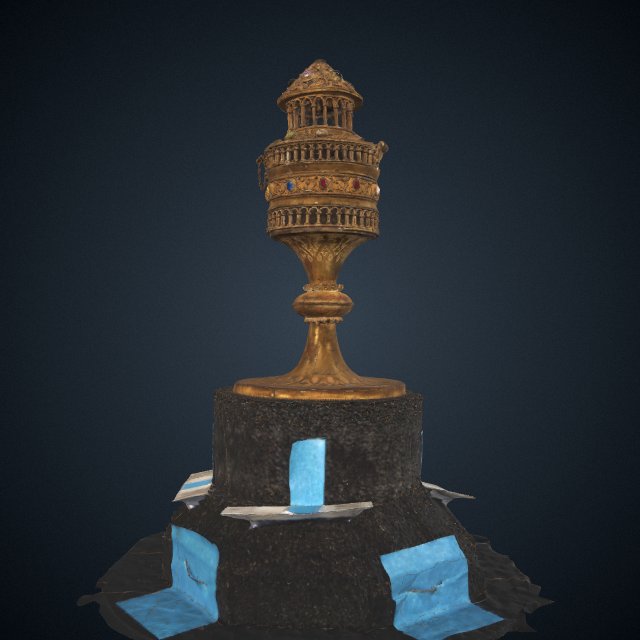
Pedicled Pyx
Origin
Flanders or Artois, ca. 1215-1225
Current location
Saint-Omer, Musée Sandelin, inv. D. 41
Dimensions
H. 16; D. 9.8 cm
Materials
Hammered copper, engraved then gilded, filigree of two joined wires, glass cabochons
Exhibitions
Paris 1965, n° 54, pl. 9; Nice 1982, document n° 14, p. 45-46; Saint-Omer 1992, cat. 3, p. 42-45; Paris 2013, cat. 90, p. 154.
History
Found, before 1854, in the cupboard of the sacristy of the former cathedral of Saint-Omer; placed on deposit at the Musée Sandelin in 1991.
State of conservation
Good general condition. The top of the lid has a hole that probably served to pass a ring through, in order to suspend the object above the altar. Originally, a solid covering (glass, crystal, or copper) placed behind the drum must have protected the consecrated hosts (the eucharistic species).
Commentary
This cylindrical gilded copper custodial (box), called a pyx or eucharistic reserve, consists of a wide cylindrical drum, topped by a hinged lid in the form of a small aedicule with a conical roof, in solid metal.
It rests on a round foot—hence the adjective “pedicled”—decorated with intaglio-engraved palmette scrollwork, with a flattened circular knop, set between two foliate collars in relief. In its upper part, three friezes of small openwork round arcades unfold, alternating with bands of coloured glass cabochons and filigree scrollwork. Made of two joined wires and a single granulation, this filigree is not without recalling that produced in the workshop of Hugo of Oignies, goldsmith monk of the priory of the same name, near Namur (Belgium): Musées des Arts Anciens, Oignies et l’orfèvrerie d’Hugo.
By its openwork structure, the work belongs to a small group of pieces of similar form, among which are the pyxes of Aywières (ca. 1225-1250, Brussels, Musées Royaux d’Art et d’Histoire, Inv. 2875), of the Walters Art Museum in Baltimore, of the museum of Amiens, of the treasury of Saint-Cunibert in Cologne, and of the Musée de Cluny in Paris (Cl. 22860).
The function of these objects—reliquaries or eucharistic reserves—was long debated. Most scholars agree in considering them pyxes intended to hold consecrated hosts.
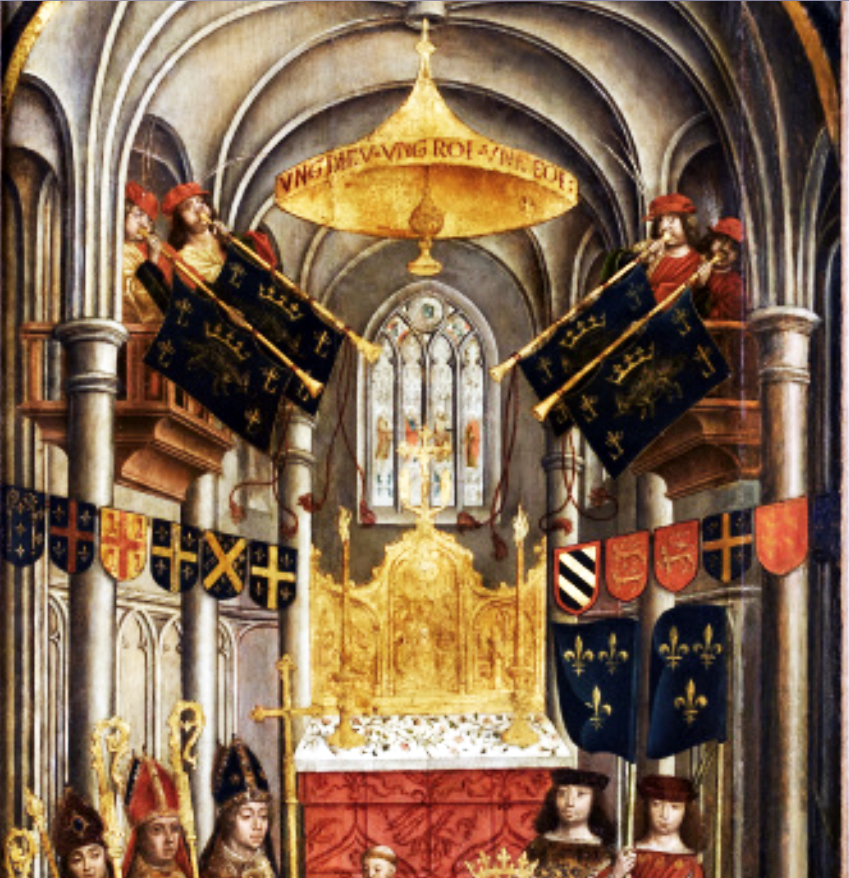
However, it is possible that some of them, fitted with a crystal that then gave them the value of a monstrance, may from the outset or at some point in their history have held relics. This is not the case with the pyx of Saint-Omer. Indeed, by the form of a turret surmounted by a conical, openwork roof, it evokes the architecture of the Holy Sepulchre in Jerusalem, as Westerners imagined it at the time. Moreover, the presence of the hole at the top of this roof, used to pass a suspension ring, refers to the eucharistic custodials of this form that had become customary to suspend above the altar, at least since the 11th century. Examples of this are attested locally in Artois and Picardy (Puys d’Amiens of 1502 (Le sacre de Louis XII), Paris, Musée de Cluny, inv. Cl. 822a, ill. detail of the eucharistic suspension above the altar).
The style of the decoration (engraved motifs and simple filigree) places the execution of the object in the first two decades of the 13th century, probably by a local goldsmith.
Bibliography
Guy Blazy (ed.), Trésor des églises de l’arrondissement de Saint-Omer, exh. cat. (Saint-Omer, Musée Sandelin, 1992), Saint-Omer, 1992, cat. 3, p. 42-45 (entry by Élisabeth Taburet-Delahaye)
- Deschamps de Pas 1854, p. 121-123
- Barraud 1858, p. 396-442
- Rohault de Fleury 1887, p. 86
- Verdier 1974, p. 257-282
- Lestocquoy 1939, p. 9-12, fig. 7
- Gauthier 1983, p. 118, n° 66
- Foucart 1989, n° 29, p. 6-16
Marc Gil, 2023